


First contact between the Iridescence and Autologist missionaries. Despite initial misconceptions, Iridescent Symbiotes are peaceful, curious creatures. However they have difficulty recognising anything as alive that isn't slathered and filled full of the heavy metal based nanite slurry that sustains much of their biology
Introduction
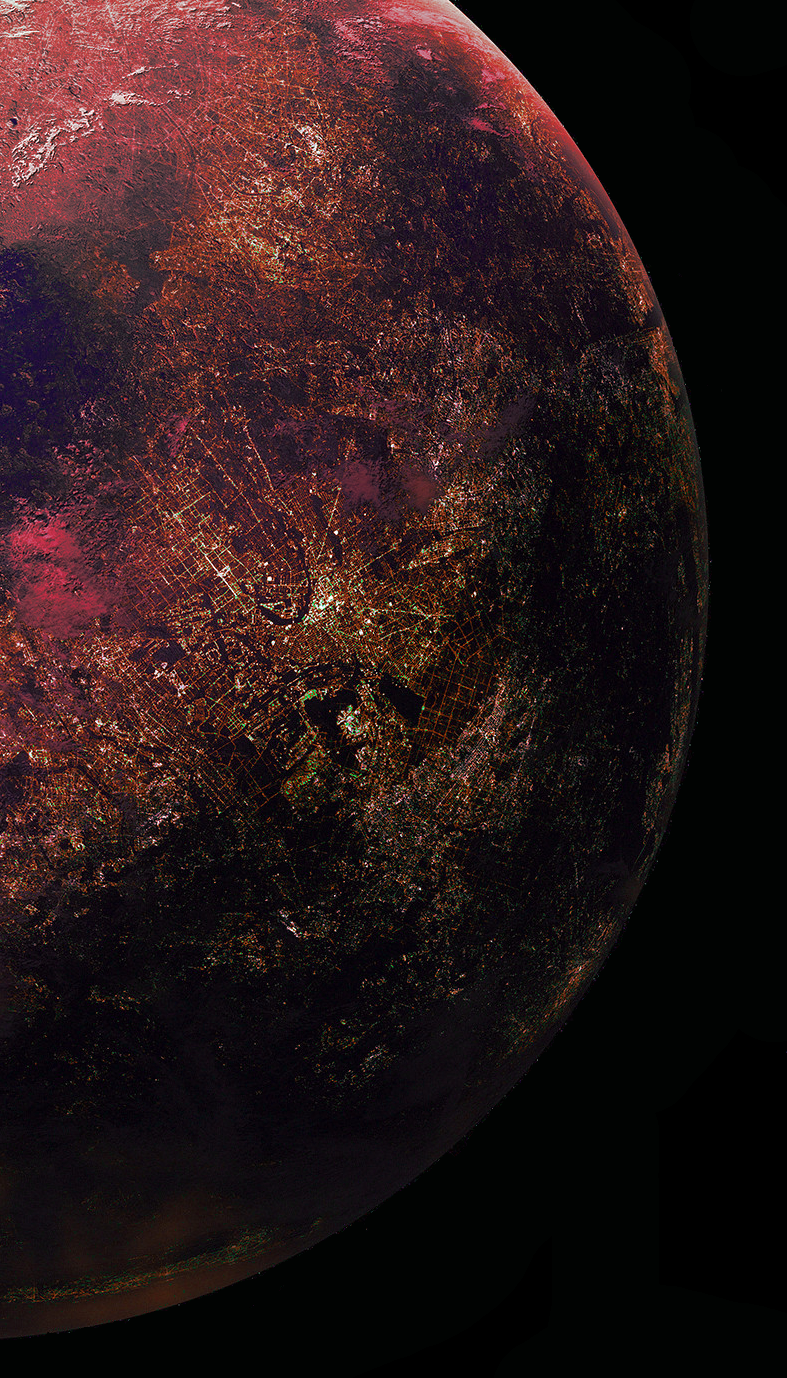
Like a cancer across a still living world, It grows. Vast masses enveloping kilometres, and spreading, always spreading, crawling like flowing magma, accreting from infinitesimal worming growths. A colony organism, one immense paradoxical lifeform like nothing else known to the Nexus. A mere sludge, a slurry, a slime - and yet its vast roots crack the crust and reach deep into the mantle, drinking greedily from the core. The substance - the being - iridesces with the molten energy of the planet itself.
Tending to it, shaping and nurturing it even as it slowly devours their world, the symbiotes are ever-dutiful gardeners. A civilisation built in the shadow of the thing that gives it life yet is its doom. Like insects infected with parasitic fungus, they unquestioningly engineer their own destruction - yet some theorise this is the wrong paradigm. The symbiotes return their dead to the slurry wastes, to be broken down by the growth - what if in truth they were never separate from it to begin with? Not a parasitised species, but merely an extrusion of the same organism?
Forging not their death but their immortality?
► Ascomy, the Devoured World

Physiology
As an individual, the symbiote is a fundamentally incomplete creature. Scoured of the luminescent sludge they constantly daub themselves in, it is the pallid, milky colour of greywater underneath; its fragile, membranous skin almost translucent save for the ridges of tougher organoplastic tissue which band its protuberant cartilaginous pseudospine.
Its organs, and the filigree-like outlines of its circulatory and nervous systems are faintly visible through the pale flesh, glowing in shifting patterns of unclean colour - its innards as inundated with the strange, iridescent growth as its body is habitually slathered in it.
It has been said that, despite all appearances to the contrary, the symbiotes are in fact similar to humanoids, being bilaterally symmetrical tetrapods.
This is very wrong.
It takes only a closer look at the tracery of softly glowing tissues within to note the fact that the symbiote is for the most part empty. That it lacks virtually all of the organ systems required to sustain higher multicelluar life, and its existence independent of the true organism - the lifegiving organometallic lifeform it imbibes - is impossible.
This growth, that to the symbiotes acts as their currency, the basis of all their technology, and their god, is in fact a megacolony which they themselves are biologically inseparable from. It appears to externally mediate much of their metabolism, outsourcing vital biological functions ranging from waste filtering and digestion, to cell repair and even reproduction itself.
The symbiotes do not seem to regard themselves as individuals distinct from this ever-growing luminescent mass, and physiologically they are not. Those with not enough of it begin to suffer cellular degradation akin to radiation sickness. Those denied it completely die within hours. The symbiote is entirely transparent by the terminal stage of deprivation, its milky fluids seeping from thousands of rupturing tears as the degeneration breaks down its entire body, starting with the fragile skin.
Ironically it is believed the slurry is just as toxic to the symbiotes as it is to all other life on Ascomy. There is nothing spectacularly biochemically different about them compared to the rest of the planet's fauna. It is hypothesised that, uniquely in their case, the growth repairs the damage it does faster than it kills them.
It was once hypothesised that the symbiotes' origin was entirely artificial, somehow created by the Iridescent growth, which controversially shows some signs of a rudimentary, very alien form of cumulative intelligence. However the possibility of an ancient, yet naturally evolving symbiosis has since become the more dominant position. The gaping orifice in the symbiotes' thoracic cavity, containing the digestive proboscis, is clear indication of an evolutionary history in which the creature once ate. The proboscis spews an enzyme mixture, now laced with the Iridescence itself, that externally digests foodstuffs or living prey. It is believed the aliens once consumed the resultant nutrient soup themselves. Now they offer it up to the Iridescence, which inundates their bodies and sustains them instead.
A triad of vestigial, shrunken organ sacs which may once have been lungs visibly occupy a considerable portion of the body's central mass. Whatever may once have been, symbiotes do not breathe. Respiration is another function provided for them by the Iridescence, which turgidly circulates through their vessels under its own power. Yet juveniles are sometimes observed palpitating their thoracic mass in an oddly familiar way, almost as if following some ancient instinct they have yet to understand is useless.
For purposes of locomotion, symbiotes mostly scuttle close to the ground, scrabbling on their stubby pair of rear extremities while grasping for handholds with the pincer-like appendages on their longer, more flexible forelimbs. However the thin, elastic membrane splayed between the forelimbs and the thorax allows the symbiote to glide short distances if it launches itself from a high position - or if it leaps. With a muscular contraction of the rear limbs it can propel itself at considerable speed over considerable distances, especially impressive considering the typical slowness of the inefficiently crawling creature. Even in this, however, the Iridescence plays its part, being the primary ingredient in a variety of chemical performance enhancers that play much the same role in symbiote cultures as alcohol and psychoactive substances do for other species. Mechanical gliders, treadcrawlers, and other technological forms of transport are powered by the very same omniutilised material. Many modern symbiotes' limbs and musculature are severely atrophied as a result of disdaining any locomotion at all under own power, preferring to rely solely on these products of the Iridescence to move. Some wealthy enough in Iridescence spend their entire lives within mechanised exoshells, their every motion fuelled by a perpetual dialysis-like circulation of the slurry.
Senses
Worming, prehensile tendrils sprout from under the hood of denser flesh that provides some measure of protection to the braincase. These delicate, highly sensitive organs provide their primary sensory modalities, and it is a traditional punishment of most symbiote cultures to sever or bind them. Exquisitely sensitive to touch and motion, they can determine the lay of the land and the proximity, speed and direction of nearby creatures simply by feeling for faint tremors in the ground. They can predict the weather by sampling air currents and scrutinise humidity and temperature for miles in every direction, locating ideal locations - and concentrations of the Iridescence, the presence of which reduces moisture and generates considerable heat.
Chemoreceptors capable of taste and olfaction are studded across much of the symbiotes' underside, but they are concentrated in a ring around the proboscal cavity. This gives them their characteristic meandering, shuffling gait, as they press their orifices close to the ground to pick up scents, taste the earth for traces of Iridescence, and detect the pheromonal messages of conspecifics. Each chemoreceptor also doubles as a minute orifice in itself through which these pheromones are excreted. As well as a form of purposeful communication, much of their emissions are unconscious and involuntary, making emotional dissemblance almost impossible for symbiotes as a result. Their mental state is being constantly broadcast.
Vision is a sense for the symbiotes, but given the extremely bright light of their O-type main sequence star, their six compound eyes remain protected under their fleshy hoods during most of the day. Exposure to the intense sunlight would rapidly damage them. At dawn and twilight, and overnight, the hood retracts slightly and their many-faceted eyes peer out. Though they have poor resolution, an inability to focus and an effective range limited to only a few yards, they provide an expansive field of vision, and the ability to look in numerous directions at once. Motion and distance are registered with great speed and accuracy. These are invaluable adaptions for a slow-moving, vulnerable creature that relies on a spring-loaded reflex to escape from danger. Their ability to detect ultraviolet also confers an advantage in identifying prey creatures and fungal colonies that signal in spectra invisible to most species, as well as predators. Naturally accreting calcite crystals grow over their lenses, giving their eyes a characteristic mottled, grainy appearance. But rather than obstructing vision, these crystals minimise spherical aberration of incoming light, and have excellent optical properties, going some way to make up for their unfocused perception.
Though their vision only becomes a significant sensory modality at night, light is not a problem. It is never truly dark on Ascomy. Even when the sun is gone the great masses of Iridescence illuminate the land over great distances. Indeed subcutaneous concentrations of Iridescence luminesce at night, seemingly in response to the symbiote's state of mind, and the auroral patterns that flicker across their bodies in darkness are the basis of all higher forms of communication. Again, their largely subconscious nature makes emotional dissemblance almost impossible, and also provides a means of effective communication between virtually any symbiote culture, regardless of language, for the meanings of colours are universal.
Hearing however is vestigial to the point of non-existence. Symbiotes can detect vibrations generated by noise with considerable sensitivity, but not noise itself. Yet this is not such a weakness as it might appear. In the low gravity of Ascomy, and given the small and extremely lightweight bodies of much of its wildlife, predators are often near-silent ambushers. The low tinnital noise given off by the energetic Iridescence that fills symbiote bodies would inure them to the whisper-subtle tread of approaching threats anyhow. Smell and touch during the day, and vision during the night, remain their best chance of evasion.
Environmental Adaption
Ascomy is a cool world, despite the brightness of its star and the carbon dioxide compsotion of its atmosphere. A runaway greenhouse effect is prevented by the planet's high albedo, the thinness of its atmosphere and its considerable distance from its star. Its days and nights are short and its axial tilt is low, keeping temperatures consistent and placid. It is a gentle, if unideal environment for life given the strict oxygen budget most of its higher creatures operate under.
But given that the Iridescence maintains virtually all of the symbiote's biological functions, what few environmental adaptions it was once necessary for its evolutionary ancestors to have are vestigial. Their remnants can be seen in certain survival instincts that tend to manifest in juveniles. Attempting what appears to be breathing with their withered pulmonary sacs is the most typical, and untrained juveniles sometimes briefly exhibit a behaviour common to most other land animals on Ascomy - kleptoplasty. A variety of inedible plants are rabidly consumed by the young symbiote for the sake of their energy-giving anthoplasts, which diffuse throughout the body giving it a curdled, reddish composition. The juvenile will often then find this alarming. The behaviour serves no purpose either - cut off from the Iridescence it will only barely slow the rate of degeneration. Juveniles usually outgrow the habit around the same time they cease the vestigial motions of breathing.
So long as it is covered in and circulating with a sufficient quantity of energised Iridescence, the otherwise fragile symbiote is also fairly impervious to any injury that is not immediately fatal. Any environmental extremes that might be encountered off-world, whether of temperature, pressure or gravity pose little threat. Even vacuum is survivable with a dense enough coating of Iridescence and enough internal flow to plug all orifices and pores. The organometal acts, perhaps instinctively, perhaps with an intelligence of its own, to protect a symbiote it is in contact with from harm. Without frequent renewal, however, its capacity to store energy is limited by volume, potentially leaving an overbold symbiote stranded in a situation it cannot otherwise survive.
Reproduction
Symbiotes possess three genders, male, female and amale, their insubstantial bodies cycling between them randomly based on seasonal hormonal pulses. Since they possess few internal organs the change requires little more than the differentiation of a few cell clusters. Though the dimorphism may be barely distinguishable by an outside observer, to the symbiotes it matters a great deal.
Virtually all symbiote culturefaiths invest the female gender, the rarest occurring, with a spiritual or oracular role, perceiving them as having a unique connection to the Iridescence. The origin of this belief doubtless lies in the nature of their pregnancies. Their bodies lack the capacity to carry an infant to term, and so they retreat to the nearest slurry-field, submerging themselves in it entirely. Months later a tide of newly formed juveniles is deposited on the steaming banks of the sludge, and the mother soon after. Sometimes they never return. Whether this is perceived as blessing or a judgement varies from culture to culture.
Males are the workhorses of society: menials, labourers, soldiers and scouts. They are suffused with hormonal vigour and strength, but they have little authority or freedom as a result, considered too impulsive for decision making. Females choose their pairbonds from among them, which last so long as their respective genders last, and often remaining as close friendships after. For the most part their choices are made based on communal standards of worth, not personal preference, and females who selfishly indulge themselves lessen the weight their word carries. In males too, a strong sexual drive is distrusted as a sign of vestigial instinct having too great a hold. The ideal symbiote relationship is one that exists solely to serve the Iridescence - and for the most part, barring those deviant exceptions, they are content with this.
The infertile amales occupy the most divergent roles, disdained by some culturefaiths as vestigial and barren. In others they are the only gender entrusted with positions of responsibility, serving their communities as respected stewards, speakers, organisers and quartermasters. Those that despise them stress that symbiotes tend to become amales after failing to procreate over many successive seasons, but it is their very lack of hormonal influence and sexuality that is the basis of their authority elsewhere.
At any rate, those that are often amales also tend to live the longest, for when symbiote's lifetime supply of gametes is exhausted, death is known to follow soon after. Yet this is a generality, not a rule. Ultimately a symbiote's lifespan is unknowable to any but the Iridescence itself. For some it abruptly ceases to give life, just as it imbues others with extraordinary vigour for centuries. As if it can determine which of its offshoots have served their purpose, and which display the greatest potential, the sustaining power of the Iridescence waxes or wanes. Some see this as the superorganism's 'judgement'. The symbiotes do not. To them it is only a simple process of renewal, fundamental as cell division. For when one dies they are returned to the Iridescence - and from their biomass mass it yields more of their kind in turn.
Psychology
The precise nature of what the Iridescence is varies from culture to culture - in some it is an all-powerful deity, in others an impersonal cosmic immanence, in others the lifegiving effluence of deep spirits of the earth. But regardless, all symbiotes instinctively know - they are the Iridescence. It is a part of them, as they are but a part of it. All symbiotes are born from its mass, and all cultures return their dead to it. The concept of the individual as such does not exist. There is only the one, the whole. The Iridescence.
Some outsiders have tried to 'save' or 'free' them from this mindset. But a symbiote can no more be convinced to stop serving the organism that destroys its planet than a human could be persuaded to stop caring for her children for the good of the enviroment. It is innate programming, utterly self-evident and irrefutable to them.
Symbiotes then have little understanding, and no fear of death, nothing beyond vestigial survival reflexes common to all living things. Their culturefaiths do not believe in an afterlife as such, not for themselves personally - they simply do not distinguish between themselves and the Iridescence, and the Iridescence is forever. The matter is immaterial. The effect on their psychology is profound, for virtually every sentient species lives in the shadow of its own mortality. It is what drives them to create, to achieve, to struggle.
So it is that to some the symbiotes seem tranquil, languidly simple-minded - but others who have seen them in action think of them as suicidally, even psychopathically reckless, both disregardful of their safety and that of others. Uncomprehending of the horror of death to other species, those symbiotes unfamiliar with aliens think little of ending a life for any purpose, even trivial ones. Those most unfamiliar with aliens struggle to accept the concept of life as distinct from the Iridescence at all. For to a symbiote, everything else in the universe, including themselves, is simply matter awaiting unity with it.
It is not the case that the creatures make no effort to avoid death. They take pains to evade or kill off their many natural predators on Ascomy. But they seem to do so more out of a sense that their lives are an obligation towards the Iridescence, rather than from fear or desire.
Juveniles are notable for an active fear and avoidance of pain, but this is a tendency weeded out of them by the Fathers through extensive exposure and conditioning. By maturity, most, if not all symbiotes are inured to it.
Rare individuals manifest more destructive natural instincts, which may be impossible to condition away. Defunct evolutionary drives such as the fear of death, selfishness, acquisitiveness. The greater whole has little regard for such antisocial perversions, and though Symbiote mentality has many admirers, there also those who baulk at their cold-blooded suppression of all that was once natural.
Society
Symbiote society appears as something of a paradox to most, given that it operates despite its constituent members - if they can be called that - having none of the needs and desires that drive civilisation on virtually every other inhabited world. If the creatures had stayed at a neolithic level of development, they would be just as well off as they are now, their every biochemical or medical need effectively catered for by an endless cornucopia of resources.
Yet the driving force behind their society is not absent, merely different. Where other species advance in pursuit of resources, security, power and pride, symbiotes have to deepen their understanding and connection with the Iridescence, and to further its manifest destiny to envelop all things.
Since the earliest periods of their history they dug tunnels and channels to direct its flow and ease its progress over difficult terrain. Today explosives, drills and dozers level entire mountain ranges in its path. Once they mined precious, lustrous metals believed to enhance the vigour of new-sprouted patches struggling to take root. Today they feed them rare earth metals scientifically proven to do so.
The concentration of power and wealth is another dynamic observers sometimes struggle to understand. Given the selfless, egoless nature of the symbiotes, it might be expected that some form of natural, perhaps even a perfect egalitarianism would emerge. This would certainly be possible - if equity and fairness was what symbiotes desired. But it is not. It is maximising the efficiency of Iridescent growth.
The symbiotes have never had rulers, exactly. There have never been chieftains or kings on Ascomy, as such social structures arise from evolutionary lust for resources and power. Their polities themselves are loose co-operatives of clans or guilds, the nomenclature varying but all essentially voluntary associations. But nonetheless, since ancient times ownership of the great slurry-mounds has been entrusted to those the collective believe will employ them best. In the past these were prophet-elders and shaman-shapers, who promised that their divine inspiration or mystical knowledge would see the Glory stretch from shore to shore within their lifetimes. Most symbiotes still believe in the ancestral rites and customs of their culturefaiths, and they are still observed in concession to that belief - but in modernity, ownership and distribution of the Iridescence is entrusted to technocratic forums dedicated to the scientific maximisation of its expansion. Still, these informal councils claim no leadership over any symbiote. They merely provide recommendations, which are invariably followed.
Of course even in so single-minded a species there will always be a few dissidents, even when their only disagreement is on how best to employ and expedite the Iridescence. And here lies another of the darker sides of their seemingly utopian existence. For while such disruptors will rarely be prevented striking out to found their own Iridescent colonies, they will not be permitted to take with them and waste even an ounce of their polity's own. Rarely such outcasts will happen upon unclaimed Iridescence to seize, but more often than not to be shunned by the collective is a slow death sentence. Ragged red trails of banished symbiotes reduced to kleptoplasty - barely slowing the rate of their disintegration - are a common sight on Ascomy.
Yet through such methods, seamless order and continuity is maintained. Symbiote polities are tens of thousands of years old, for almost none have ever fallen in recorded history. The very same that once mastered fire, invented writing and the wheel bestride Ascomy today. It should be surprising then that as soon as global communications and travel became a possibility, the creation of a unified world forum was inevitable. Some look at what they percieve as the systematic violence and cruelty of the symbiotes and question how this unity is possible. But while juvenile conditioning and punitive justice is practiced, primarily against those who cleave too closely to defunct instincts and animal selfishness, war has never blighted the surface of Ascomy. Symbiotes do not particularly value life - but they do see all their kind as useful conduits for the Great Work. To kill, even for the sake of acquiring Iridescent mass that one believes could be put to better use, is to strike against the Thing itself. For all are the Iridescence.
At most, small bands ritual warriors have duelled over competing plans for a newfound a slurry-field, the result ungrudgingly accepted for the greater good. In modernity overwhelming shows of military pre-eminence serve the same purpose, with weapons of great destruction unleashed against typically unmanned military targets with few if any casualties. Even such displays are becoming increasingly irrelevant in an interconnected world, where such matters can be settled by negotiation, mutual exchange or the outright unification of polities. Much like the Iridescence itself, its symbiotes are gradually coalescing.
