

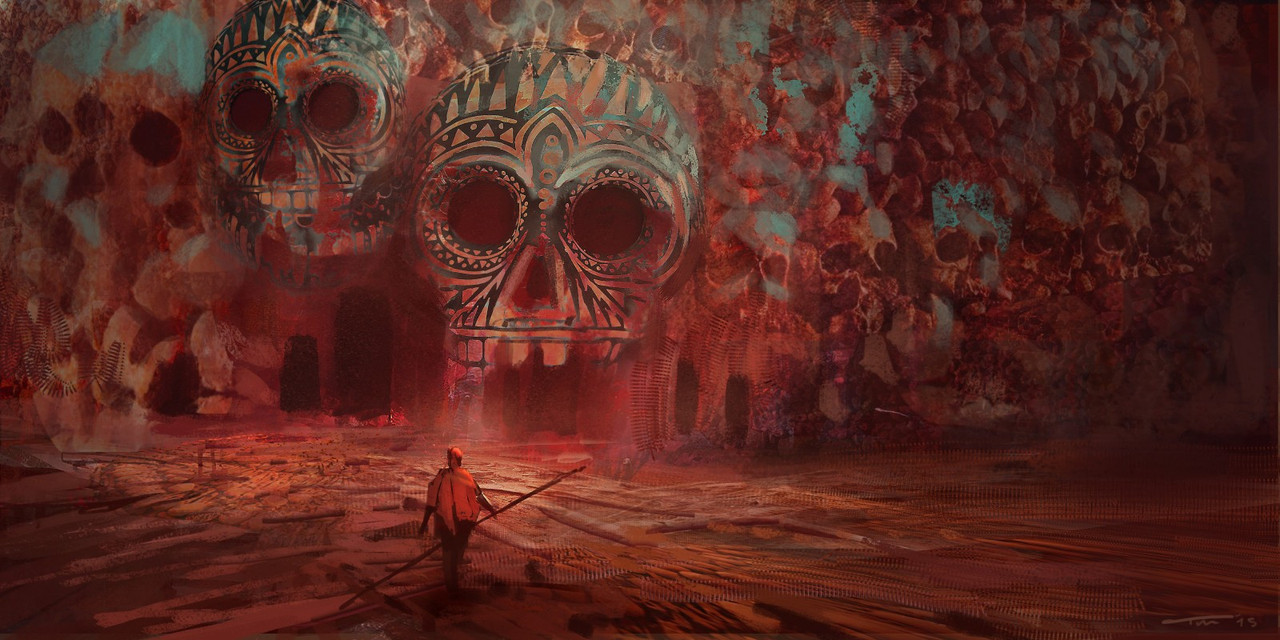
If there is a truly divine creator deity, or pantheon, it is impossibly distant and unknowable to the mortal world. What its religions call gods are most often nothing but figments of myth or garbled legends of lost civilisations, though a few revere entities that are very real: powerful and ancient demiurge-beings that long ago shaped the mortal races from the slimes and heats of the earth. Some can still be called upon by their worshippers. Others slumber in the deeps, or have forgotten or abjured their creations.
Above their world, in the high darkness beyond the skies, the Outer Spheres reign. Primal, alien and serene. These cosmic powers are indifferent to the mortal realm, and their existence is unknown to all but the most esoteric and forbidden of occult lores. They are not true divinities any more than the demiurges of the earth, but they too have been worshipped in the high, remote places where their distant power is most felt.
On Magic
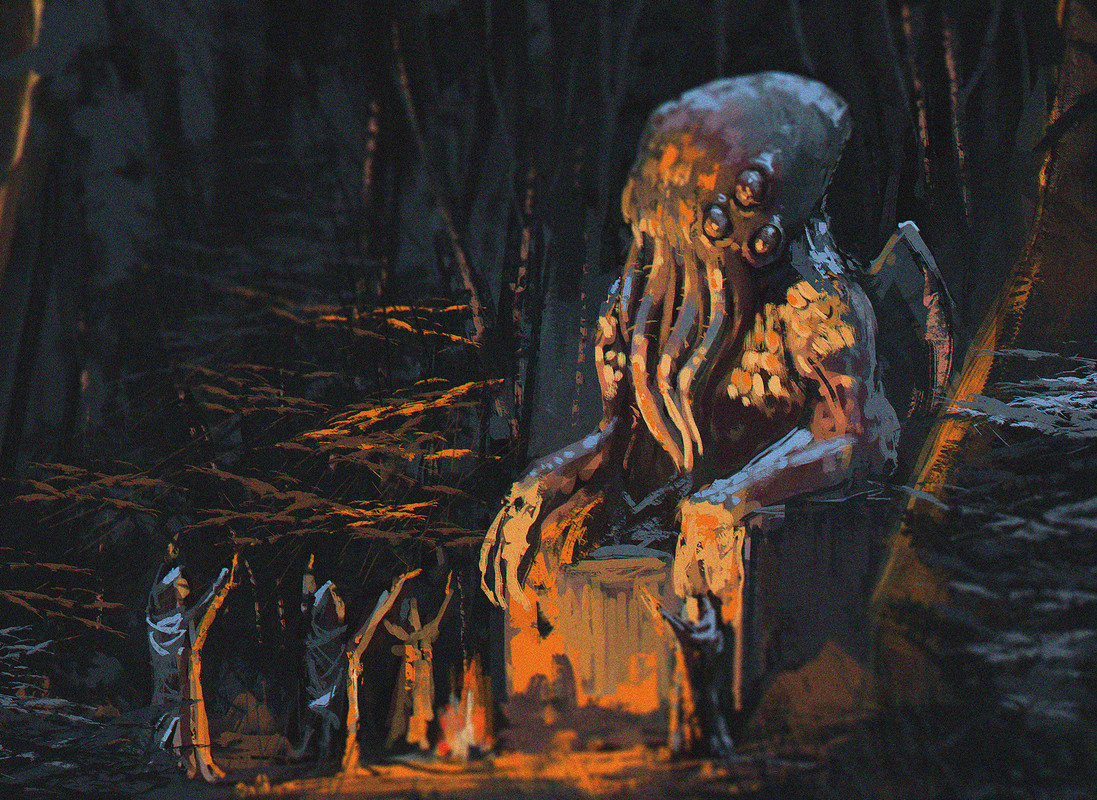
There are as many kinds of magic as there are higher beings whose power can be drawn upon. Some may have been practiced only by a single civilisation, even a single remote tribe, in one place and one time before they were lost forever. Others have been discovered independently by many civilisations across the ages, or have diffused throughout the world with the vagaries of conquest, migration and trade.
These are such practices:
Evocation; variously known as Exomancy, Spirifage, or Necromancy
First mastered by man in ancient Thumeru - though by other races both later and earlier - this elder art has been forbidden, forgotten, rediscovered and forbidden again countless times over the eons. In some lands it is only a legend, the stuff of superstitious folklore or occultist fancy. In others it is practiced openly, a weapon, tool or plaything of the rich and powerful - though even in these societies, its true nature is rarely known to more than a secretive few.
Its essential principle is the summoning of an incorporeal spirit from the astral realm of the Spheres, and binding it into a material substrate in which it can be controlled. Though the process is often called necromancy, this is a misnomer, as dead hunks of flesh and bone are not fundamentally different from any other kind of inanimate matter. The human body is simply a practical substrate, when treated and preserved, since it already has a skeleton and working muscles. Possessing the dead is therefore the cheapest means of creating a useful servant. Only lesser entities of the outer dark can be bound to such a paltry vessel, however, and these twisted, subsentient creations are suitable only for brute labour of violence.
More powerful and intelligent beings must be bound into purpose-made constructs crafted by master artisans. These mechanical or golem-like forms may be crude steam-driven devices or intricate clockwork automata, but however they function they must contain gemstones and rare metals, which conduct the intelligential energies of the bound entity through the material. The more powerful the entity, the more powerful conductors are required. A wealthy merchant prince may be waited on by servants made of platinum, inlaid with ivory and studded with blue diamonds. A lesser lord may have a single servitor of bronze, studded with opals and quartz. But even these are rare and extravagant marvels. Setting aside the sheer expense of the materials, there is still the expertise required to build them, and the occult lore necessary to animate them, rendering them costly no matter their design.
They are also dangerous, though few of the lords and princelings who sleep at night with mechanical servants pacing the halls are aware of this. The true nature of their animating intelligences is rarely understood beyond the secretive guilds, covens or clans - whoever it is - that summons and binds them. Even they may have a garbled knowledge filtered through superstition or faith. The truth is that these astral things are utterly alien, and though they may become proficient at imitating human emotion and mannerisms, it is always an act. They hail from the abstract, unseen realms of the cosmos, where these things do not exist. All they truly feel is something akin to hatred, the contempt of a higher being forced to inhabit a lesser world, forced to slave at the whims of animate meat.
On Spirits
All mortals live in the shadow of death, and their civilisations are built on its denial. Though almost every culture and creed teaches otherwise, the mortal races are foremost things of flesh, blood, and energy, and life does not require any spiritual essence to exist. Most are animate meat, awaiting oblivion.
Yet the primordial demiurge-beings that some call gods created mortalkind for myriad purposes, some benevolent, some malevolent, others indifferent and others unknowable - and some imbued their creations with incorporeal essences, while others did not. If it is their creators' will, these might even remain coherent beyond bodily death, and possess some kind of independent existence. There is no single answer for what awaits the mortal races after death, though oblivion is to be hoped for compared to some fates...
On Airships
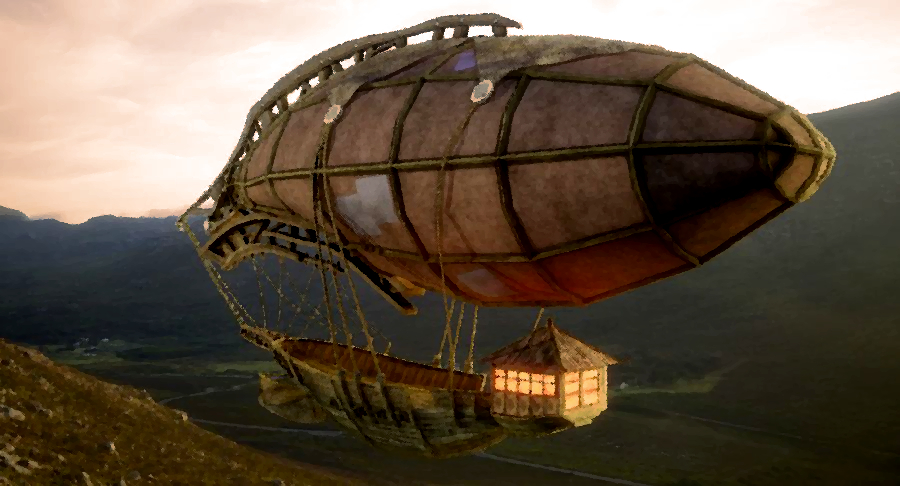
Gunpowder, magnetism, clockwork and telescopy - an age of wonders is dawning that may yet surpass the works of the ancients. In the greatest empires and wealthiest cities, fabulous airships now cross the skies. Many dream they will change the world. But that hasn't happened, at least not yet. For they are as fragile and unreliable as they are fabulously expensive. Only master craftsman can build their exquisitely lightweight frames, made from delicately wrought metal and expertly hewn wood, even the hollow bones of exotic skybeasts. They rely on painstakingly produced alchemical gas, usually worth far more than whatever meagre cargo an airship can carry. A single volley of shot will tear one apart, and a storm or blizzard will spell its certain doom. Even a strong gale will put all but the most experienced crews in mortal peril. Unsuitable for commerce they remain aristocratic luxuries, only unmoored on clear cloudless days. Some ambitious rulers have attempted to use them to transport diplomats or spies with unprecedented speed, but anyone important enough to require such haste is probably too important to risk on an airship.
